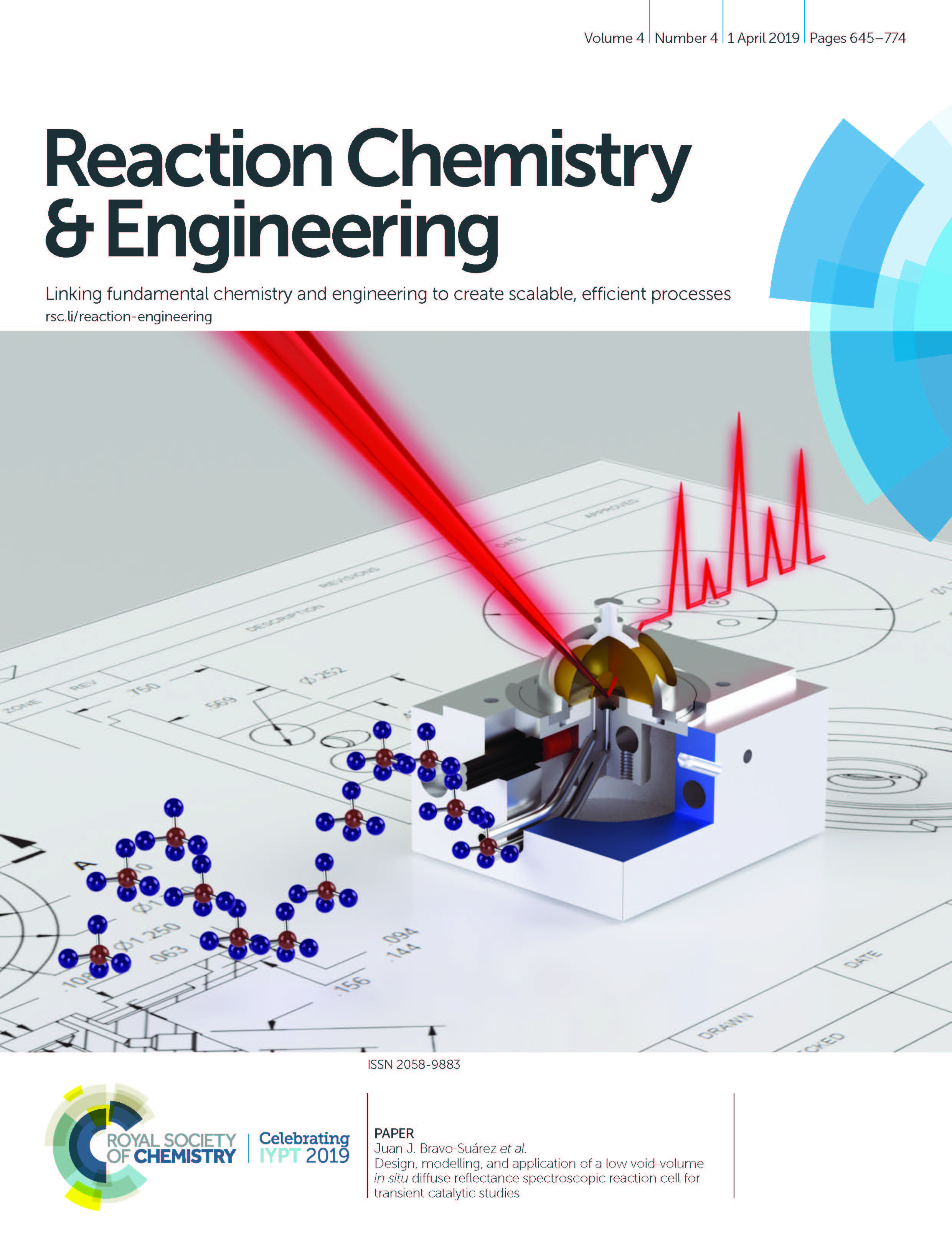
"“Application of modulation excitation-phase sensitive detection-DRIFTS for in situ/operando characterization of heterogeneous catalysts”"
Featuring Featuring Juan Bravo Suárez and his research group members Priya D. Srinivasan, Bhagyesha Patil, and Hongda Zhu
Abstract
This work describes the application ofin situ/operando modulation excitation-phase sensitive detection-diffuse reflectance Fourier transform spectroscopy (ME-PSD-DRIFTS) for the characterization of heterogeneous catalysts. ME was enabled using a low void-volume diffuse reflectance cell which allowed rapid gas exchange (gas residence times <2 s) and by periodic feed concentration changes to the reaction cell by a simple switching valve system that provided quasi-square shaped modulation. PSD analysis of a relatively large data set of rapid scan spectra over many periodic cycles was done via a discrete Fourier transform (DFT)/frequency filtering/inverse discrete Fourier transform (IDFT) procedure. A general description of the ME-PSD principle, mathematical framework, guidelines for planning, running, and interpreting results was provided while focusing on ME-PSD-DRIFTS. Aspects such as the modulation frequency and amplitude, modulation waveform, sampling rate, in situ cell residence time, and limitations and future opportunities for ME-PSD-DRIFTS were also discussed. The proposed DFT/IDFT methodology uncovered the use of frequency magnitude plots for the evaluation of spectra baseline shifts, signal response to modulation, the response waveform type, noise, and signal decay/growth. Additionally, ethanol dehydration on γ-Al2O3 was presented as an example of application of the ME-PSD-DRIFTS methodology
Citation
Srinivasan, P.D., Patil, B.S., Zhu, Hongda, and Bravo-Suárez, J. Application of modulation excitation-phase sensitive detection-DRIFTS for in situ/operando characterization of heterogeneous catalysts. React. Chem. Eng., 2019, 4, 862-883